
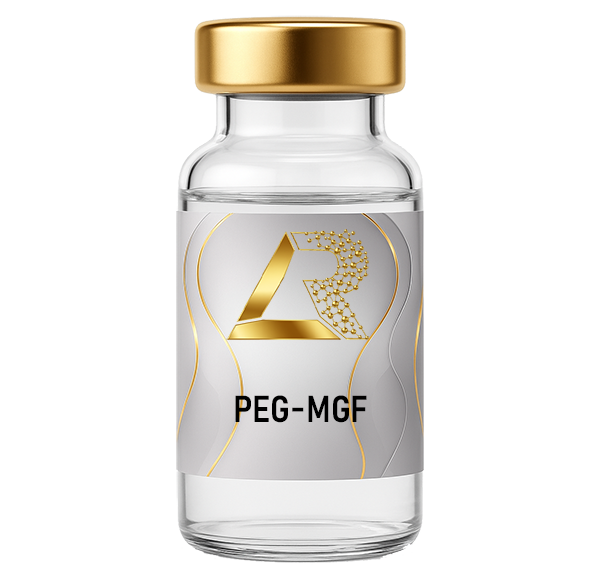
PEG-MGF 2MG

PEG-MGF is the pegylated form of Mechano Growth Factor, a peptide crucial for activating muscle stem cells for tissue repair. This modification dramatically increases its stability and half-life, making it a subject of intense research for its potent effects on muscle recovery and localized hypertrophy.

$50.00

The information provided on this page is intended solely as a general summary. It does not encompass all potential research applications, handling procedures, safety precautions, interactions, or observed effects. These products are supplied strictly for laboratory and research purposes only. They are not intended for human consumption, medical use, veterinary use, or diagnostic purposes. This information must not be considered a substitute for professional expertise, judgment, or regulatory guidance.

Money Back Guarantee

Guaranteed Quality

Fast Shipping

10+ Years Experience

Frequently Bought Together

Original price was: $50.00.Current price is: $45.00.
Original price was: $110.00.Current price is: $81.00.
Original price was: $120.00.Current price is: $81.00.
Original price was: $55.00.Current price is: $49.50.
Original price was: $335.00.Current price is: $256.50.
For 4 items

SEQUENCE/FORMULA

Sequence: Tyr-Gln-Pro-Pro-Ser-Thr-Asn-Lys-Asn-Thr-Lys-Ser-Gln-Arg-Arg-Lys-Gly-Ser-Thr-Phe-Glu-Glu-Arg-Lys

Molecular Formula: C121H200N42O39

MOLECULAR WEIGHT

2888.2 g/mol

PUBCHEM CID

Not available
  • Investigating its role in promoting the proliferation and differentiation of muscle satellite cells (stem cells), which are crucial for muscle repair.
  • Studying its potential to induce localized muscle hypertrophy (growth) and accelerate recovery from muscle injury.
  • Analyzing its therapeutic potential in conditions involving muscle wasting (sarcopenia) and muscular dystrophy.
  • Researching its neuroprotective effects and its potential to aid in the repair of nerve tissue following injury.
  • Exploring how the extended half-life due to PEGylation improves its efficacy compared to standard MGF.
  • Mechano Growth Factor (MGF) is a splice variant of the Insulin-like Growth Factor 1 (IGF-1) gene, specifically expressed in response to mechanical stimuli (like exercise) or tissue damage.
  • It primarily acts by stimulating the division of muscle satellite cells, providing new nuclei for muscle fiber repair and growth, a process distinct from the mature IGF-1Ec isoform.
  • PEGylation is the process of attaching a Polyethylene Glycol (PEG) chain to the MGF peptide. This shields the peptide from rapid enzymatic degradation in the bloodstream.
  • This shielding dramatically increases the peptide's circulating half-life from minutes to several hours, allowing for a more sustained and effective biological action at the site of injury.
  • Goldspink, G. (2005). Mechanical signals, IGF-I gene splicing, and muscle adaptation. Physiology, 20(4), 232-238.
  • Matheny, R. W. Jr., et al. (2010). Mechano-growth factor induces satellite cell proliferation and enhances hypertrophy in overloaded rectus femoris muscles of rats. Tissue and Cell, 42(3), 152-158.
  • Mills, P., et al. (2007). Mechano-growth factor E peptide promotes healing of deep dermal thermal injury in a porcine model. Wound Repair and Regeneration, 15(4), 549-555.
  • Veronese, F. M., & Pasut, G. (2005). PEGylation, successful approach to drug delivery. Drug Discovery Today, 10(21), 1451-1458. (This paper discusses the principles and benefits of PEGylation technology).